
Glutaric aciduria type 1 (GA1) is caused by an inherited deficiency of glutaryl-CoA dehydrogenase (GCDH), leading to the accumulation of neurotoxic metabolites. This autosomal recessive neurometabolic disorder is clinically characterized by encephalopathic crises, which can result in brain injury and severe movement disorders in untreated infants. Despite newborn screening and early pre-symptomatic start of therapy, approximately one-third of patients still develop neurological symptoms, representing a significant disease burden.
Within the CHARLIE consortium (https://charlie.science/), Prof. Stefan Kölker and his group at Heidelberg University Hospital, in collaboration with the German Mouse Clinic, Helmholtz Center Munich, and the University of Florence, investigated the impact of substrate reduction therapy in GA1.
The team analyzed the biochemical and clinical effects of aminoadipate semialdehyde synthetase (Aass) knockout in Gcdh knockout (KO) mice, a well-established model for GA1. AASS is a mitochondrial enzyme that catalyzes the first two steps of the saccharopine pathway—the primary lysine degradation pathway in mammals—and functions upstream of GCDH. Using this model, the researchers aimed to determine whether Aass deficiency could prevent the accumulation of toxic metabolites, such as glutaric acid and 3-hydroxyglutaric acid, and thereby influence disease progression.
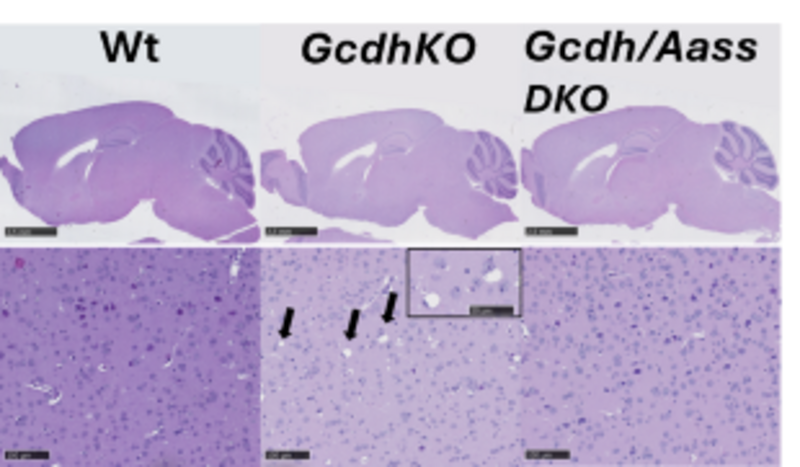
Analysis of Gcdh/Aass double KO mice showed that these animals were clinically indistinguishable from wild-type mice and exhibited a marked reduction in the main toxic metabolite, glutaric acid, in brain, liver, and urine. The reduction was less pronounced for 3-hydroxyglutaric acid. Importantly, unlike Gcdh KO mice, Gcdh/Aass double KO mice did not develop a severe phenotype when exposed to a high-lysine diet (HLD). These mice demonstrated improved overall clinical and neurological outcomes, increased weight gain, and a reduced rate of seizure-like behavior compared to Gcdh KO mice under HLD conditions. In addition, striatal architecture was preserved, and near-complete behavioral rescue was observed. Notably, no overt toxicity or developmental abnormalities were detected in the Gcdh/Aass KO cohort. Individuals with hyperlysinemia caused by AASS deficiency typically exhibit mild or no symptoms, further supporting the safety profile of this enzyme as a therapeutic target.
Overall, this study demonstrates that depletion of AASS can partially rescue the severe phenotype observed in Gcdh KO mice. These results provide compelling preclinical evidence that pharmacological targeting of AASS may transform the therapeutic landscape of GA1.
Saad C, Jung-Klawitter S, Dimitrov B, Aguilar-Pimentel JA, Becker L, da Silva-Buttkus P, Dragano NRV, Garrett L, Hölter SM, Rathkolb B, Sanz-Moreno A, Spielmann N, Fuchs H, Gailus-Durner V, Schaaf CP, la Marca G, Damiano R, Lefeber DJ, Engelke U; CHARLIE Consortium; Hrabe de Angelis M, Houten SM, Kölker S. Aminoadipate-semialdehyde synthase, a potential target for substrate reduction therapy in glutaric aciduria type 1. Sci Rep. 2026 Mar 31;16(1):10995. doi: 10.1038/s41598-026-44377-9. PMID: 41917075